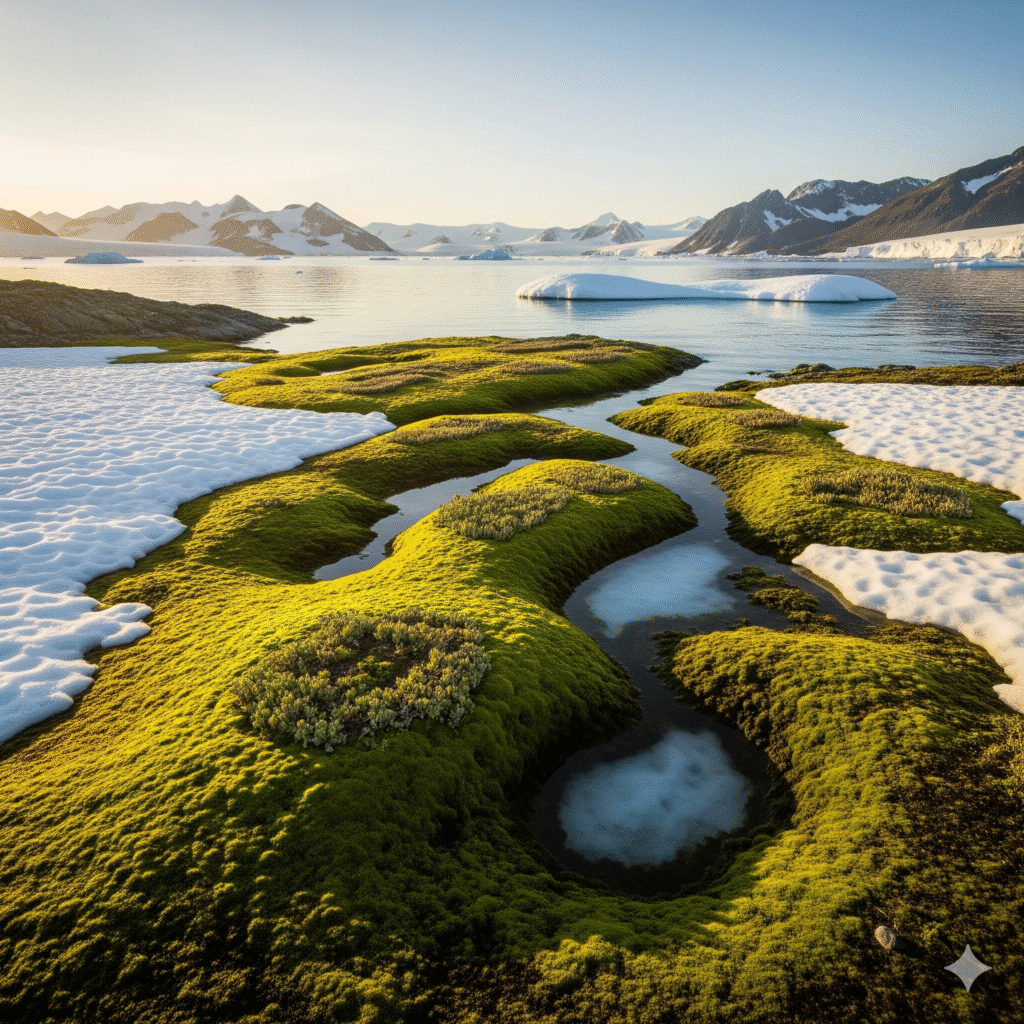

Accelerating plant growth in Antarctica refers to the rapid increase of mosses, lichens, and two small flowering plants – the Antarctic hair grass and pearlwort – on land once buried under ice. This shift is fuelled by rising temperatures, longer melt seasons, and higher carbon dioxide levels, transforming one of Earth’s harshest environments into a surprising hotspot of ecological change.
Antarctica Isn’t as Frozen as We Thought
When I first saw satellite images showing “green blooms” in Antarctica, I had to double-check the captions. Could this really be happening in the coldest place on Earth? Turns out, yes. Researchers have documented a twelve-fold increase in plant cover on the Antarctic Peninsula between 1986 and 2021. (ScitechDaily)
To put it in perspective, that’s like watching a handful of seeds on your windowsill suddenly spread across your entire garden in just a few seasons. And the pace is quickening. Between 2016 and 2021, growth rates spiked to 0.424 km² per year – much faster than in previous decades.
Why now?
- Warmer air and longer summers. Ice is retreating, leaving bare rock and soil exposed long enough for plants to anchor and spread.
- More CO₂ in the air. Higher carbon dioxide acts like extra food for photosynthesis. Imagine someone giving your houseplants a growth booster – that’s essentially what’s happening globally. (UGA Extension)
- Moisture shifts. Melting ice provides trickles of water. In an environment where every drop counts, this is a game-changer.
But before we celebrate, let’s pause. This greening is not just a symbol of life thriving – it’s also a warning light blinking on the dashboard of Earth’s climate system.
How Scientists Track Antarctic Greening
Now, you might be wondering: “Okay, but how do we actually know the plants are spreading?” Great question. I asked myself the same thing. Turns out, the methods are as fascinating as the findings.
- Eyes in the sky. Satellites like Landsat capture detailed images, letting scientists compare patches of green over decades. The subtle shift in color signatures shows photosynthesis at work.
- Boots on the ground. Teams trek across rocky outcrops, measuring moss cushions and counting hair grass shoots. I once joined a small expedition in Greenland to do something similar with lichens – it’s tedious, cold, finger-numbing work, but incredibly rewarding when you see a splash of green against the ice.
- Ice-core clues. Air bubbles trapped deep in ice layers reveal past CO₂ levels, helping connect today’s plant growth with atmospheric changes over centuries.
- Climate models. Researchers simulate future scenarios – what happens if the warming trend continues? Will these plants keep spreading, or will they hit natural limits like poor soil or water shortages?
It’s a mix of detective work and time travel, blending satellite pixels with frozen air samples and field notebooks scribbled in gale-force winds.
How Antarctica Compares to Other “Greening” Hotspots
Antarctica isn’t alone in this story. Other regions are turning greener too—but for different reasons.
- The Arctic. Across Siberia and northern Canada, shrubs are advancing into tundra. It’s a sibling story to Antarctica, though the Arctic has more soil, nutrients, and species to start with.
- Drylands. Some deserts show patches of greening when rainfall patterns shift. Unlike Antarctica, they’re limited more by water than by cold.
- Tropical forests. Here, rising CO₂ has boosted growth in some places, but heat stress and deforestation cancel out the gains.
The difference? Antarctica is starting almost from scratch. Where the Amazon struggles to keep balance, the Antarctic Peninsula is like a blank slate suddenly being sketched with the first strokes of green.
The Double-Edged Sword: Why Antarctic Greening Matters
So, is this good news or bad? The honest answer: both.
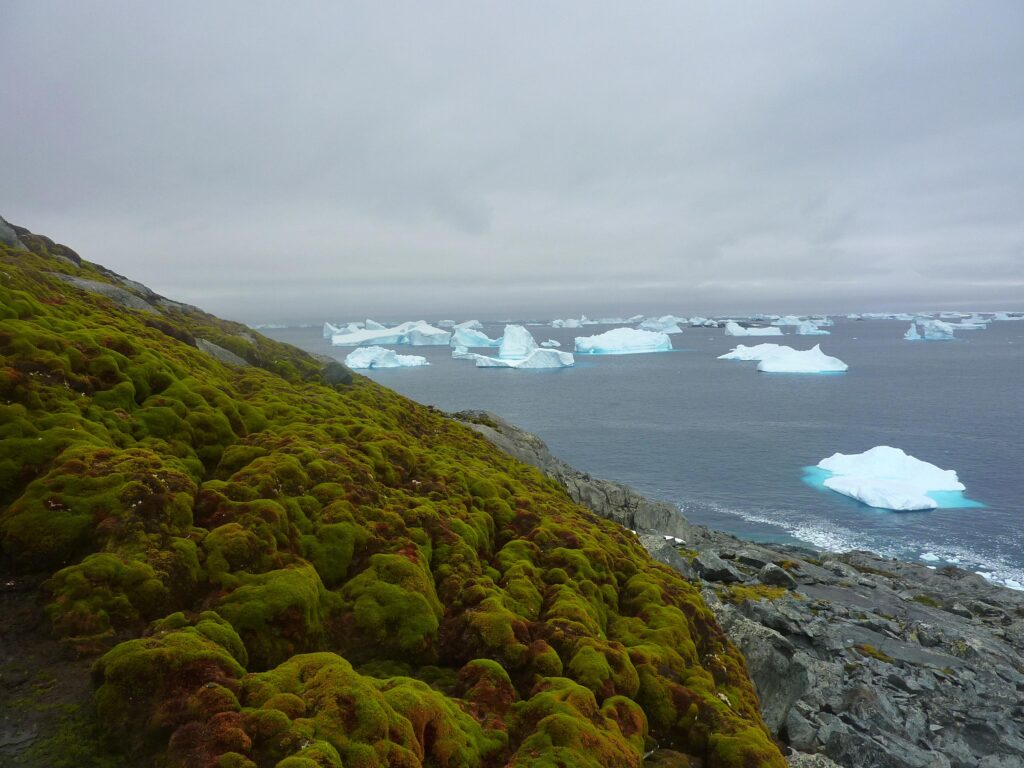
The Upside
- Carbon storage. Even a thin mat of moss locks away a little carbon. Not much compared to a forest, but symbolically important.
- New ecosystems. More plants mean richer soil, which supports microbes, insects, and maybe more complex life down the road.
- Science in action. For climate researchers, Antarctica is a natural laboratory. What happens here gives us clues about how ecosystems everywhere respond to rapid change.
The Catch
- Invasives. Imagine a seed from South America hitching a ride on a tourist’s boot. If it takes root, it could overwhelm fragile native plants.
- Feedback loops. Green absorbs more heat than white snow. More plants could actually accelerate melting by darkening the surface.
- Fragility. The soil is thin, nutrients are scarce, and plants are vulnerable. A single hot, dry season could wipe out years of slow growth.
As Dr. Thomas Roland of the University of Exeter puts it:
“The landscape is still almost entirely dominated by snow, ice and rock, with only a tiny fraction colonised Aby plant life. But that tiny fraction has grown dramatically – showing that even this vast and isolated wilderness is being affected by anthropogenic climate change.” (ScitechDaily)
His words echo something I felt standing on a glacier in Iceland years ago: awe mixed with unease. The sight of moss on bare rock was beautiful, but I couldn’t shake the question – what does this beauty cost us?
FAQs
Q: Is the plant growth in Antarctica permanent or just seasonal?
It’s mostly seasonal, tied to summer melt. But as more land stays exposed year-round, some of this greening is becoming permanent. Think of it as a foothold for future ecosystems.
Q: Does this extra greenery help fight climate change?
A little, but not much. The total area is tiny compared to forests. It’s more of a signal – showing us how fast the planet is changing – than a solution.
Q: Could invasive species really reach Antarctica?
Yes. Tourists, researchers, and even windborne seeds pose a risk. Native plants are tough but not competitive. That’s why biosecurity measures – like cleaning boots before landing – are so strict.
Q: Is CO₂ the main driver, or is it warming temperatures?
Both matter. Without warmth, plants can’t grow even with high CO₂. Without CO₂, growth is slower. Together, they’re like fuel and a spark.
Q: How fast is the greening happening?
Since the late 1980s, vegetation has spread from less than 1 km² to nearly 12 km² in the Antarctic Peninsula, with the pace quickening sharply after 2016.
Conclusion
Here’s the bottom line: Antarctica’s accelerating plant growth is a paradox. It’s hopeful in the sense that life finds a way, even in the harshest corners of Earth. But it’s also sobering, because this greening is tied directly to melting ice and rising CO₂ both clear fingerprints of human activity.
For me, the sight of moss pushing through frozen ground is both inspiring and unsettling. It reminds us of Earth’s resilience, yes, but also of our responsibility. The next time you see a patch of grass spring back after winter, think of Antarctica because even there, at the ends of the Earth, the green story is unfolding faster than ever.
For me, the sight of moss pushing through frozen ground is both inspiring and unsettling. It reminds us of Earth’s resilience, yes, but also of our responsibility. The next time you see a patch of grass spring back after winter, think of Antarctica because even there, at the ends of the Earth, the green story is unfolding faster than ever.
So, what do you think does this greening give you hope, or does it leave you uneasy?