
Introduction
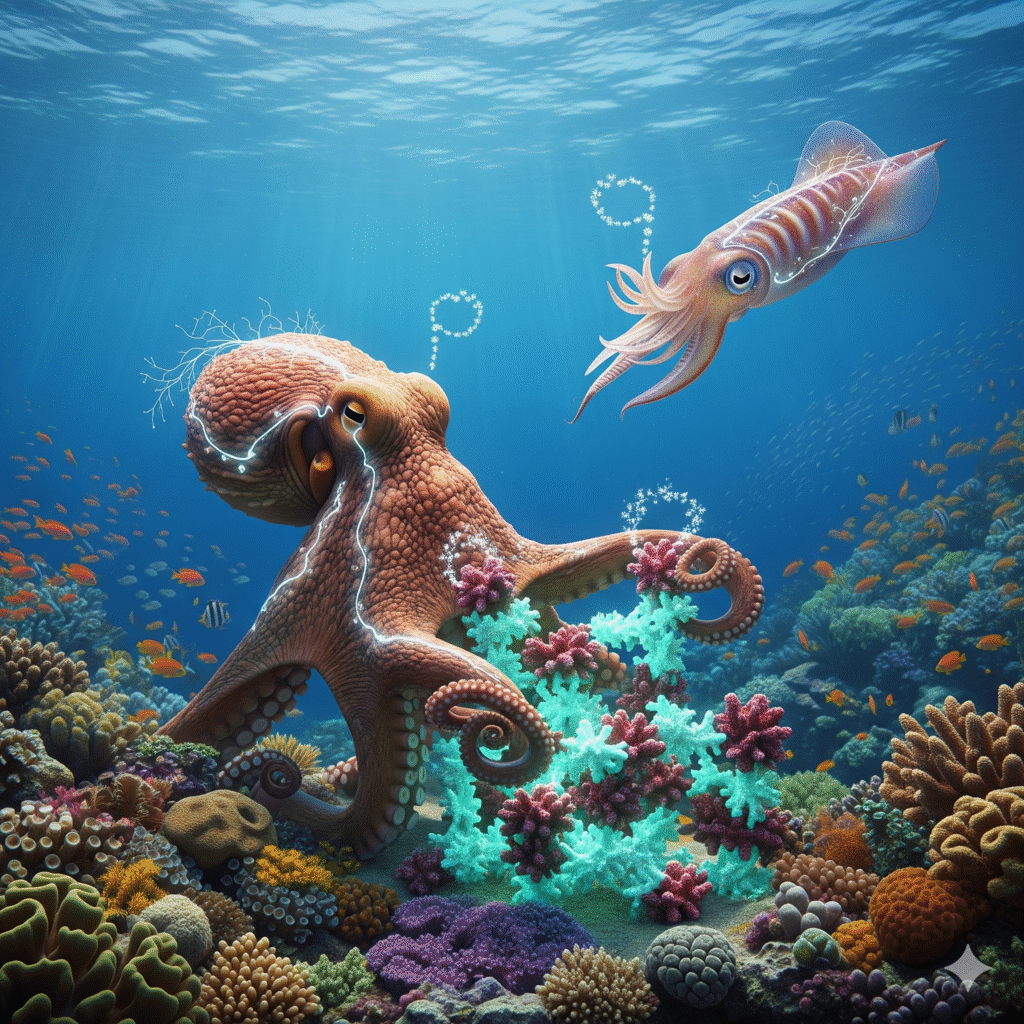
Have you ever watched an octopus solve a puzzle or escape from an aquarium enclosure and thought, “How on earth is that possible?” It’s mesmerizing, almost magical-but science tells us it’s biology at work. Octopuses and squids are not just clever; they are astonishingly intelligent for invertebrates. But the real question is: how do they achieve such cognitive feats with a brain structure so different from ours?
Recent research suggests that a remarkable genetic oddity might hold the key. These cephalopods have evolved unique RNA-editing mechanisms that allow them to fine-tune their neural proteins in real time. In other words, their brains are constantly upgrading themselves based on experience and environment. Understanding this could change how we define intelligence-not just for humans, but for the animal kingdom as a whole.
Why Cephalopod Intelligence Is So Surprising
When we think of smart animals, mammals like dolphins or primates come to mind. Octopuses and squids, however, challenge that expectation. Their nervous systems are decentralized-two-thirds of an octopus’s neurons reside in its arms rather than its central brain. This means each arm can act semi-independently, performing complex tasks without input from the “main” brain.
I remember visiting an aquarium where a veined octopus carefully unscrewed the lid of a jar to retrieve a treat inside. It was a slow, deliberate process, almost like watching a tiny, tentacled engineer at work. This kind of intelligence is astounding for an animal whose evolutionary path diverged from vertebrates hundreds of millions of years ago.
Neuroscientists, including Dr. Clifton Ragsdale from the University of Chicago, note that cephalopods’ behaviour isn’t just impressive-it’s evolutionary proof that intelligence doesn’t require a large, centralized brain.
How the Genetic Oddity Works
You might be wondering: what exactly is this genetic quirk that sets octopuses and squids apart? The answer lies in RNA editing.
- RNA Editing vs. DNA
While most animals’ DNA provides a fairly fixed blueprint for proteins, octopuses and squids can edit RNA after transcription. Think of it as real-time software updates for their neurons, allowing rapid adaptation to new situations. - Neural Flexibility
RNA editing affects synaptic proteins-molecules critical for communication between neurons. This flexibility enables cephalopods to learn, remember, and even anticipate problems in ways that would surprise many mammal-centric scientists. - Environmental Adaptation
Studies show that environmental factors, like temperature or food availability, influence RNA editing patterns. Essentially, their brains can “tune” themselves to the challenges of the ocean in near real-time. - Research Findings
At the Scripps Institution of Oceanography, researchers discovered thousands of RNA edits in neural genes of the common octopus (Octopus vulgaris). These edits are concentrated in regions associated with learning, motor control, and sensory perception, highlighting a molecular basis for their intelligence.
“The extent of RNA editing in octopuses is unlike anything we see in vertebrates. It provides a mechanism for rapid adaptation and may underlie the sophisticated behaviors we observe,” says Dr. Joshua Rosenthal, a leading cephalopod geneticist at the Marine Biological Laboratory. Read the study here.
How Octopuses and Squids Compare to Other Intelligent Animals
We often equate intelligence with brain size, but cephalopods rewrite that narrative. Dolphins, corvids, and primates all rely on fixed DNA-driven proteins for their cognitive abilities. Octopuses and squids, however, leverage RNA editing to adapt and evolve neural function on the fly.
| Animal | Brain Structure | Genetic Mechanism | Intelligence Highlights |
| Octopus | Central + distributed neurons | RNA editing | Problem-solving, learning, camouflage |
| Squid | Central + arm neurons | RNA editing | Complex behaviors, color-changing communication |
| Dolphin | Centralized brain | DNA-based | Social learning, memory, tool use |
| Crow | Centralized brain | DNA-based | Tool use, problem-solving |
This decentralized yet highly flexible neural network allows cephalopods to act independently, solve puzzles, and even exhibit personality traits. It’s intelligence built not from sheer size, but from adaptability and molecular ingenuity.
Real-World Benefits and Applications
Understanding cephalopod intelligence is more than an academic exercise-it has real-world implications:
- Neuroscience and Medicine: Learning how RNA editing shapes neural function could inspire therapies for neurodegenerative disorders like Alzheimer’s or Parkinson’s.
- Robotics and AI: The decentralized control system in octopus arms has inspired soft robotics designs, creating machines capable of complex, adaptive movement.
- Education and Outreach: Highlighting these animals’ intelligence sparks curiosity in students and the public, encouraging engagement with genetics, marine biology, and evolution.
- Evolutionary Insights: Cephalopods demonstrate that intelligence isn’t exclusively tied to brain size or social complexity, challenging conventional evolutionary models.
I’ll never forget the first time I watched an octopus navigate a maze in a lab setting. It was precise, deliberate, and eerily human-like. Moments like that remind us why studying these animals matters-not just for science, but for the wonder it brings.
FAQs
Q: Are all octopus species equally intelligent?
No. Intelligence varies by species. Common octopuses and veined octopuses are known for problem-solving and tool use, while others show more basic behaviors.
Q: How does RNA editing make them smarter?
RNA editing allows neurons to produce a variety of proteins on demand, enhancing adaptability, learning, and memory-essentially “customizing” the brain for environmental challenges.
Q: Could this research benefit humans?
Potentially. Insights into RNA editing may lead to breakthroughs in neurodegenerative disease treatment, cognitive enhancement, or even bio-inspired computing systems.
Q: Do squids use the same mechanism?
Yes. While studied less than octopuses, squids show similar RNA-editing patterns in genes related to neural function and adaptability.
Q: Does this change our understanding of intelligence?
Absolutely. It shows intelligence can arise from flexible, molecularly adaptive systems—not just large, centralized brains.
Conclusion
Octopuses and squids are proof that intelligence comes in many forms. Their genetic oddity-extensive RNA editing-provides a dynamic, adaptable foundation for learning, problem-solving, and complex behavior. These creatures challenge our mammal-centric view of intelligence and open doors to innovations in neuroscience, robotics, and evolutionary biology.
Next time you see an octopus open a jar or escape an enclosure, remember: their smarts aren’t just in their arms-they’re written in their genes, constantly evolving with every challenge the ocean throws at them.