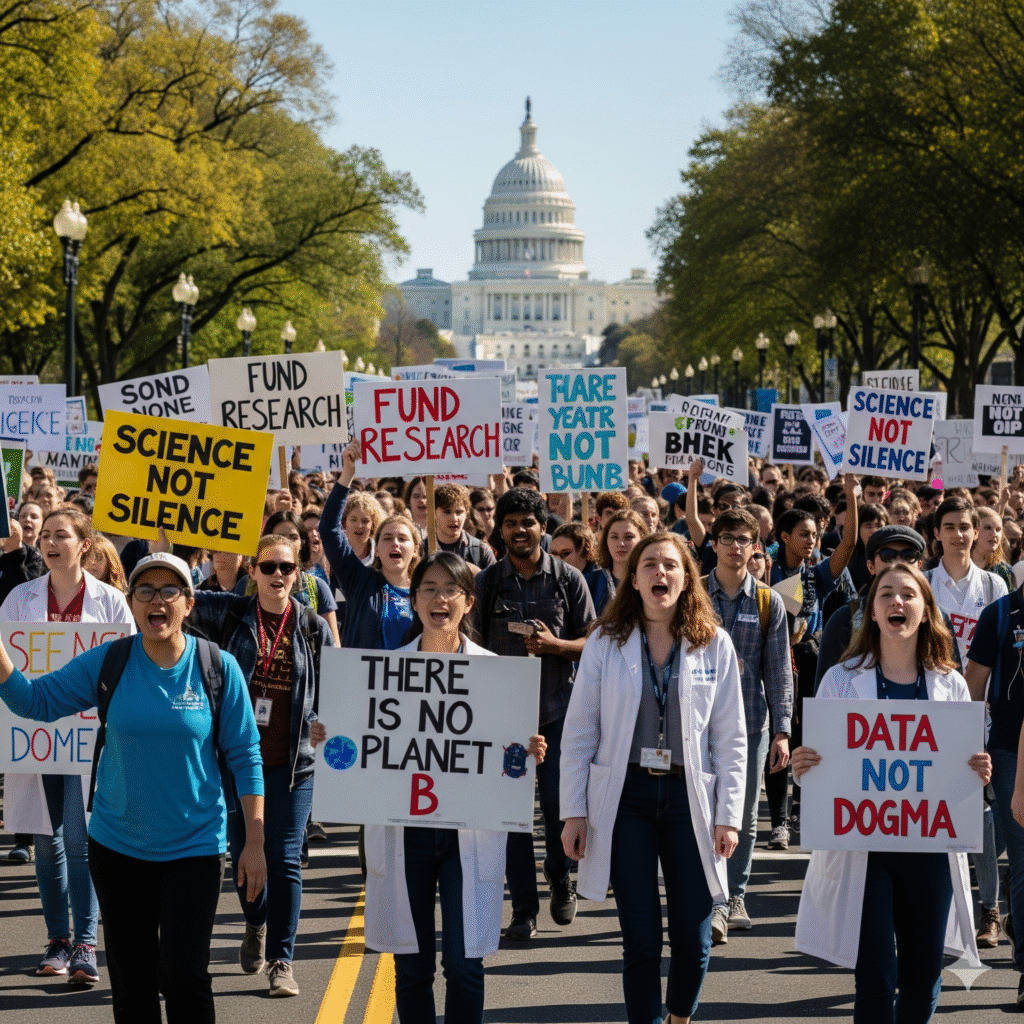

Walking through the streets of Washington D.C., it’s impossible not to notice the palpable energy in the air. Hundreds of scientists, students, and advocates, armed with colorful signs and a sense of urgency, are making their voices heard. For many, this march isn’t just a demonstration—it’s a stand for the very integrity of scientific research. With recent policies under the Trump administration affecting climate, environmental regulations, and research funding, scientists feel under siege. And in a world increasingly shaped by data and evidence, this moment matters to all of us.
The Problem: Why Scientists Feel Under Siege
You might be wondering, “Why are scientists so concerned?” The answer lies in a mix of policy shifts and direct impacts on research. Under Trump’s administration, funding cuts for agencies like the Environmental Protection Agency (EPA) and the National Oceanic and Atmospheric Administration (NOAA) raised alarms. These cuts threatened vital programs that monitor climate change, protect endangered species, and maintain public health.
Take climate data, for instance. Programs that track rising temperatures, ocean levels, and greenhouse gas emissions are essential for understanding the trajectory of global warming. When these programs are at risk, policymakers and communities lose critical insights. As Dr. Jane Lubchenco, former NOAA administrator, emphasized, “Science doesn’t have a voice on its own. If the data isn’t preserved and communicated, society suffers.”
It’s not just about abstract numbers. Communities relying on scientific predictions for flood management, wildfire prevention, or public health guidance suddenly face uncertainty. And for scientists, years of painstaking research could be rendered inaccessible—or worse, erased.
How Scientists Are Responding: Marching, Advocating, and Protecting Data
So, what does this march look like on the ground? Imagine a mix of white lab coats, casual attire, and determined faces. Signs read, “Science is not a partisan issue” and “Protect Research, Protect the Future.” Social media amplifies the movement, turning local demonstrations into a nationwide conversation.
Participants aren’t just protesting—they’re educating. Scientists hand out brochures explaining how specific policy changes impact climate modeling, medical research, and environmental safeguards. Some carry physical copies of climate data, reminding onlookers of the tangible importance of these numbers.
For many participants, the march is personal. Dr. Miguel Hernandez, an ecologist from California, shared, “I’ve spent a decade studying coastal ecosystems. Seeing regulations roll back overnight feels like watching your work vanish before your eyes. This march is my way of standing up, not just for science, but for the planet.”
Beyond marches, advocacy includes lobbying, writing op-eds, and hosting public forums. Universities and research institutions provide platforms for scientists to communicate their findings and concerns directly to the public and lawmakers.
Comparing Approaches: Protests, Policy, and Public Awareness
While marching grabs headlines, scientists also consider alternative strategies. Lobbying Congress, partnering with NGOs, and publishing accessible reports are critical. But here’s the catch: policy decisions without public awareness often move faster than advocacy efforts. That’s why marches serve a dual purpose—they’re both symbolic and strategic.
Compared to other advocacy methods, public demonstrations generate immediate visibility. When images of hundreds of scientists fill newsfeeds, policymakers face pressure from constituents who suddenly understand the stakes. Contrast that with quietly submitting letters to committees—effective, yes, but lacking the same viral reach.
Yet marches aren’t perfect. Some critics argue that politicizing science risks eroding public trust. Scientists must balance activism with credibility, ensuring their message remains evidence-based and nonpartisan. The challenge is walking that fine line—being vocal without appearing biased.
Benefits and Real-World Impact of Scientific Advocacy
Why does all this matter to you? Because the policies these scientists are challenging directly affect public safety, health, and environmental resilience. Consider climate data: accurate measurements guide infrastructure planning, disaster preparedness, and agricultural strategies. Without it, cities may underprepare for floods or wildfires, farmers might miscalculate crop cycles, and entire ecosystems could suffer.
Moreover, advocacy strengthens public understanding of science. People attending rallies learn why preserving research matters. Schools and community groups often organize side events, turning protests into educational opportunities. This ripple effect helps bridge the gap between scientists and society, fostering trust in data-driven decisions.
Finally, the march sends a powerful message globally. When scientists organize collectively, it signals to international observers that research integrity is non-negotiable. Policies don’t exist in a vacuum—climate change, environmental conservation, and public health are worldwide concerns.
Expert Insight: Perspective from the Field
Dr. Elizabeth Kolbert, Pulitzer-winning science journalist, remarked in a 2017 interview, “These marches aren’t about politics—they’re about survival. The erosion of scientific infrastructure threatens not just knowledge, but the ability to respond to crises that affect every citizen.” Her insight underscores the stakes: defending science is, ultimately, defending society itself.
FAQs About Scientists Marching
Q1: Are these marches political or scientific?
While some view them as political, the intent is to protect the integrity of science and public access to data. Scientists emphasize that evidence-based research should inform policy, regardless of party lines.
Q2: How can the public support these efforts?
Individuals can attend events, share credible information online, contact representatives, or donate to science-focused nonprofits that promote transparency and research funding.
Q3: Does marching actually change policies?
Protests alone may not enact legislation, but they raise awareness, pressure lawmakers, and complement lobbying and advocacy efforts that collectively influence policy decisions.
Q4: Which scientific areas are most affected?
Climate research, environmental protection, medical studies, and public health monitoring are particularly sensitive to funding cuts and policy rollbacks.
Q5: Are these actions global or U.S.-specific?
While the marches described focus on the U.S., scientists worldwide often collaborate to advocate for research integrity, especially in areas like climate change and infectious diseases.
Conclusion: Why This Matters to Everyone
Watching hundreds of scientists march isn’t just a spectacle—it’s a reminder that research, data, and evidence shape our daily lives. Policies affecting climate monitoring, environmental protection, and scientific transparency ripple outward, impacting everything from disaster preparedness to public health. By standing up, these scientists aren’t just defending their work—they’re protecting communities, ecosystems, and future generations.
So next time you hear about science marches, don’t dismiss them as niche activism. They’re a clarion call for all of us to value evidence, support research, and ensure decisions affecting our planet are informed, not arbitrary. Because when science is under siege, the consequences extend far beyond the lab.
External References: