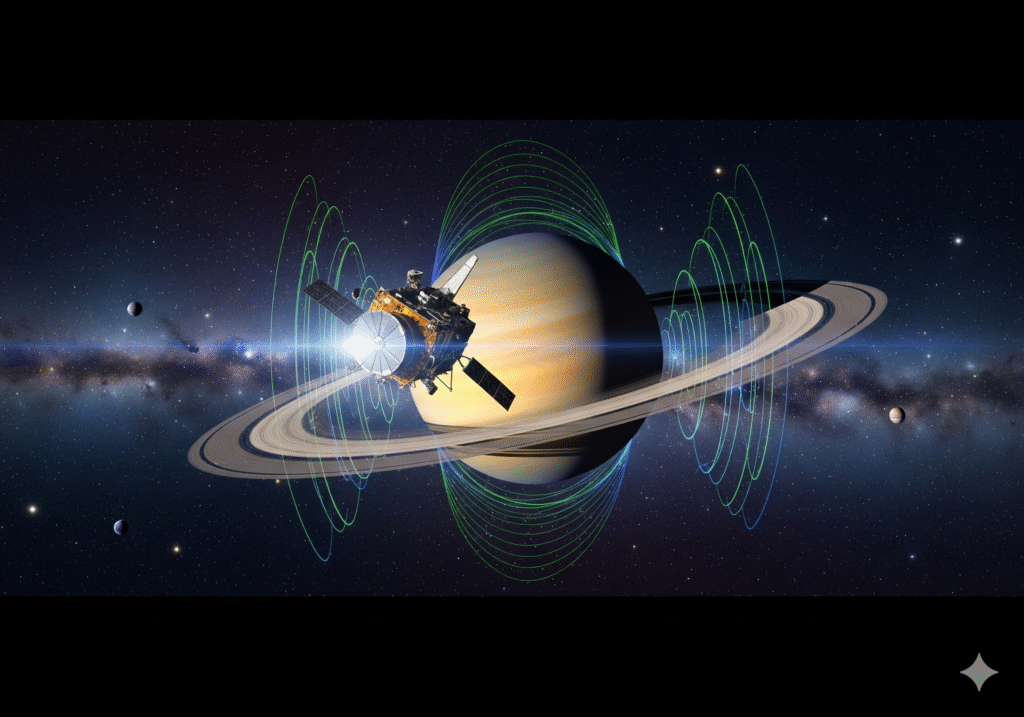

Have you ever wondered what space would sound like if we could actually hear it? Most of us picture space as silent—a vast, empty void. But thanks to NASA’s Cassini spacecraft, we now know that planets like Saturn have their own kind of music. From swirling storms to the whisper of its rings, these sounds aren’t audible in the traditional sense, yet scientists have transformed them into recordings that are as eerie as they are mesmerizing. Understanding these “sounds of space” offers more than just a cool listening experience—it’s a window into the complex dynamics of our solar system and the ingenious ways humans can study it.
Understanding the Mystery: What Makes Saturn Sing?
Space isn’t truly silent. While there’s no air to carry sound waves, charged particles moving through magnetic fields generate electromagnetic vibrations. Cassini’s Radio and Plasma Wave Science (RPWS) instrument detected these subtle oscillations during its years orbiting Saturn. Scientists then processed this data, translating it into sounds we can hear—creating a “cosmic soundtrack.”
I remember listening to one recording for the first time: a low, wavering hum, punctuated by sharp pops. It almost felt alive, like the planet itself was breathing. This is more than novelty—these sonifications help researchers detect patterns invisible in standard data sets. According to NASA, some of these waves even hint at interactions between Saturn’s moons and its rings, offering clues about the planet’s gravitational ballet.
How Scientists Turn Data Into Sound
The process might sound like science fiction, but it’s actually a carefully choreographed combination of physics and creativity. Here’s how it works:
- Detection: Instruments like RPWS record the electromagnetic vibrations of charged particles moving in Saturn’s magnetosphere.
- Data Conversion: Specialized software converts wave frequencies into the audio range humans can hear, often slowing them down or adjusting pitch.
- Analysis: Scientists listen for patterns that indicate solar wind interactions, storms, or ring dynamics.
- Sharing: The recordings are made public, letting educators, students, and space enthusiasts experience planetary phenomena firsthand.
Think of it like tuning into a radio station that broadcasts not music, but the raw rhythms of a planet. In a way, you’re standing on Saturn’s rings without leaving Earth.
Space Sonification vs. Traditional Imaging
We’ve long relied on photos from Hubble, Voyager, and Cassini to understand planets. But sound adds a new dimension. While images capture static snapshots, sonification reveals movement and dynamics over time.
- Traditional Imaging: Shows storms, rings, and surface features. Static but visually striking.
- Sonification: Highlights interactions invisible in images—like magnetosphere oscillations or plasma wave patterns.
When I compared a visual storm image to its corresponding sound recording, it was striking. The storm’s intensity didn’t just show—it sounded like a deep, oscillating hum. It was science, yes, but also art. NASA’s sonification efforts even inspired musical projects, bridging the gap between research and creativity.
Why Listening Matters: Scientific and Educational Benefits
You might wonder, “Why go through all this trouble to hear a planet?” Beyond the cool factor, these recordings are vital tools:
- Research Insight: Sound reveals patterns and anomalies that images might miss. Researchers can identify storms, solar wind effects, or ring-moon interactions.
- Public Engagement: Hearing Saturn’s “voice” sparks curiosity, making science accessible and inspiring the next generation of explorers.
- Educational Resources: Educators can use recordings to explain complex physics concepts in classrooms or public demonstrations.
- Interdisciplinary Applications: Musicians and artists have used planetary sounds for composition, merging science and culture.
As Dr. Linda Spilker from NASA’s Jet Propulsion Lab notes, “Sonifying spacecraft data allows both scientists and the public to connect with the universe in a more tangible way. It’s like bringing space closer to home.”
Experiencing Cassini’s Sounds in Miami, Florida
Planetariums and science museums across the U.S.—including Miami—now feature immersive exhibits where visitors can hear Saturn. You can sit in a darkened dome, watch visuals of the rings, and listen as the plasma waves hum around you. It’s an unforgettable reminder of the universe’s hidden wonders, right in your backyard.
FAQs
1. Can we really hear space?
Not in the traditional sense. Space lacks air to carry sound waves, but instruments detect electromagnetic vibrations, which scientists convert into audio signals humans can perceive.
2. What is sonification?
Sonification is the process of turning data—like satellite readings—into sound. It’s commonly used to analyze patterns and engage audiences creatively.
3. Why Saturn’s plasma waves?
Saturn’s magnetosphere and rings create complex interactions. Plasma waves reveal how charged particles move and react, offering insight into storms, moons, and magnetic dynamics.
4. How can I listen to these recordings?
NASA’s Cassini archive (link) offers public access to a variety of sound clips and interactive experiences.
5. Do other planets have “sounds”?
Yes! Jupiter, Uranus, and even the Sun emit electromagnetic vibrations that can be sonified, allowing us to hear patterns across the solar system.
Conclusion
Listening to the “sounds” of Saturn is more than a scientific curiosity—it’s an experience that combines data, art, and wonder. Thanks to Cassini, we can connect with a distant planet in a profoundly human way, appreciating the rhythm and movement that images alone cannot convey. So next time you glance at the night sky, imagine the hidden symphony of planets around you. And for a truly unforgettable experience, explore NASA’s sound archives and let Saturn speak for itself.