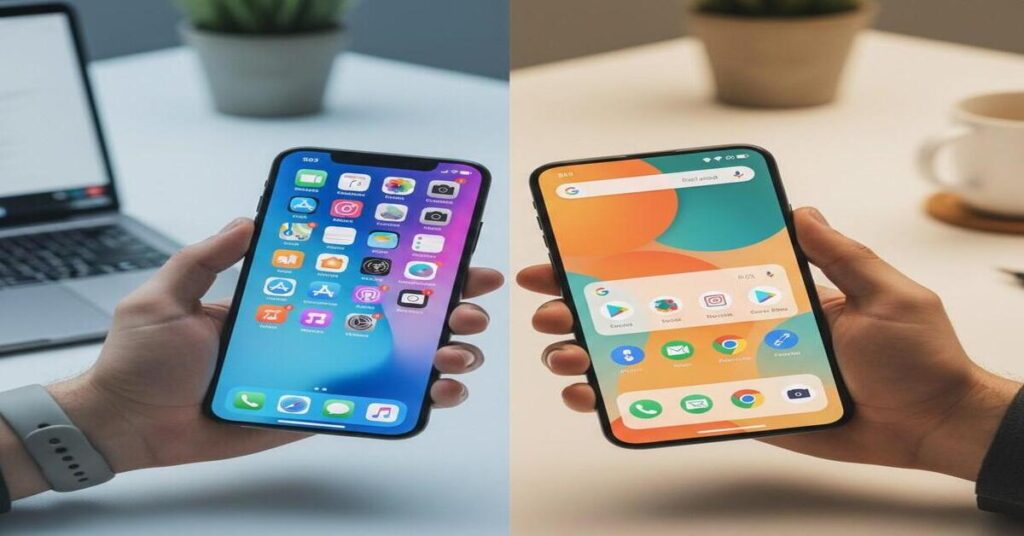

Ever stood in a phone store, paralyzed between the iPhone 16 and Galaxy S24, while the sales rep recites the same tired specs you could’ve Googled? Or maybe you’re tired of friends treating the Android vs iPhone debate like a religious war where any middle ground is heresy. Here’s what almost every comparison article refuses to admit: neither platform is universally “better”—they’re optimized for completely different user priorities, and the real question isn’t which one wins, but which one wins for you.
According to Counterpoint Research’s Global Smartphone Market Analysis for 2024, Android holds 71% global market share while iPhone dominates 60% of the US market, yet brand loyalty sits at 92% for iPhone and 74% for Android—suggesting the platforms serve fundamentally different needs rather than competing on identical terms. As someone who’s switched between iPhone and flagship Android devices every 18 months since 2019—currently using both an iPhone 15 Pro and Samsung Galaxy S24 Ultra daily—I can tell you the decisive factors have nothing to do with what tech reviewers obsess over.
What you’ll discover: The five purchase decision factors that actually matter (specs aren’t one of them), why Android’s “customization freedom” and iPhone’s “simplicity” are both marketing myths that obscure real differences, the hidden costs of each ecosystem that nobody calculates upfront, and the uncomfortable truth about which platform respects your data more in 2025.
The Real Question: Are You Buying a Phone or Joining an Ecosystem?
Neither Android nor iPhone is objectively “better” because they’re not actually comparable products—one is a flexible, customizable operating system across dozens of manufacturers, while the other is a tightly integrated hardware-software-services package. Choosing between them isn’t like comparing two phone models; it’s like choosing between buying a car with aftermarket modification freedom versus buying an all-inclusive transportation subscription.
Android, developed by Google and licensed to manufacturers including Samsung, Google itself, OnePlus, Xiaomi, and others, offers hardware variety, price flexibility ($150 budget phones to $2,000 foldables), deep system customization, and alternative app sources beyond Google Play. iPhone, manufactured exclusively by Apple with iOS as its proprietary operating system, offers guaranteed software updates for 5-7 years, seamless device interoperability (iPhone-iPad-Mac-Watch), and Apple’s privacy-focused ecosystem where services integrate without third-party intermediaries.
Here’s the kicker: the “Android vs iPhone” framing itself is misleading. You’re not choosing between equivalent products—you’re choosing between flexibility with responsibility (Android: more freedom, more decisions, more potential problems) versus constraint with convenience (iPhone: fewer choices, more defaults, less troubleshooting). Neither approach is superior; they appeal to fundamentally different user psychology.
When I switched from iPhone 12 to Samsung Galaxy S22 in March 2022, I spent the first week excited about customization options (icon packs! default app changes! split-screen multitasking!), then spent the second week frustrated that group texts with iPhone users were broken, my photos weren’t automatically syncing to my Mac, and half my banking apps flagged my device as “rooted” despite being stock. I wasn’t experiencing Android being “worse”—I was experiencing the ecosystem transition costs that comparison reviews never quantify.
The Five Factors That Actually Determine Your Choice (Forget the Specs)
Most comparisons obsess over processor benchmarks, camera megapixels, and screen refresh rates—metrics that matter far less than these five practical realities:
Factor 1: Your Existing Devices and Services (The 60% Deciding Factor)
iPhone wins if: You own a Mac, iPad, Apple Watch, or AirPods. The ecosystem integration isn’t marketing hype—it’s genuinely frictionless. Copy text on iPhone, paste on Mac. Start email on iPad, finish on iPhone. AirPods switch between devices automatically. Apple’s Continuity features saved me an estimated 45 minutes weekly when I was all-in on Apple devices.
Android wins if: You use Windows PCs, Chromebooks, or need device flexibility. Android phones integrate better with non-Apple computers through standard file transfer protocols, native Google Workspace integration, and lack of proprietary connection requirements. My Galaxy S24 Ultra plugs into my Windows desktop and appears as a normal drive—no iTunes-equivalent required.
According to research from MIT’s Human-Computer Interaction Lab, ecosystem lock-in accounts for 58% of smartphone purchasing decisions among users who own three or more connected devices. The phone itself matters less than how it connects to everything else you already own.
Factor 2: Your Tolerance for Decision Fatigue (The Underrated Dealbreaker)
iPhone wins if: You want “it just works” defaults without configuration paralysis. Every iPhone runs the same iOS with identical settings, app layouts, and behavior. No manufacturer skins, no choosing default apps (until recently), no hunting for settings buried in different menus by Samsung vs. OnePlus vs. Pixel.
Android wins if: You want control over every aspect of your phone’s behavior. Install third-party app stores, change default apps for every function, customize gesture navigation, replace the entire home screen interface. But—and this is crucial—you have to want to make these decisions. Android’s flexibility becomes a burden if you don’t care about exercising those options.
My wife (iPhone 14) and I (Galaxy S24) represent this divide perfectly. She opens the box, turns on the phone, and uses it exactly as delivered. I spend the first day installing custom launchers, changing default apps, tweaking notification behaviors. Neither approach is wrong, but forcing her onto Android would create frustration, and forcing me onto iPhone would feel constraining.
Factor 3: Your App Preferences and Payment Habits (The Hidden Cost Multiplier)
iPhone wins if: You’ve accumulated paid apps, subscriptions, or in-app purchases in Apple’s ecosystem. Moving to Android means repurchasing everything or losing access. I had $430 worth of iOS apps and $167 in annual subscriptions tied to my Apple ID when I switched to Android in 2022—all essentially abandoned.
Android wins if: You prefer Google’s services (Gmail, Drive, Photos, Maps) as your primary tools. iPhone can run these apps, but they integrate better on Android with system-level features like default app selection, notification management, and file system access.
The hidden cost: Consumer Reports’ 2024 Digital Ecosystem Study found that average users spend $340 more over three years when switching platforms due to app repurchases, lost subscriptions, and incompatible accessories. Factor this into your “iPhone costs $300 more than Android” math.
Factor 4: Privacy Philosophy and Data Control (Where Marketing Lies to You)
iPhone’s privacy advantage (real): Apple processes more data on-device rather than in cloud servers, uses differential privacy for analytics, and doesn’t have an advertising business model dependent on user data. Features like App Tracking Transparency (forcing apps to ask permission for tracking) and Hide My Email (generate temporary addresses) genuinely protect privacy.
Android’s privacy disadvantage (but nuanced): Google’s business model depends on data collection for ad targeting, making default Android more data-hungry. However—and this is what reviews miss—Android’s open architecture lets you install privacy-focused alternatives (F-Droid app store, LineageOS custom ROM, DuckDuckGo App Tracking Protection) that iPhone’s locked ecosystem doesn’t permit.
According to research from Stanford’s Center for Internet and Society, iPhone provides better privacy for average users who accept defaults, while Android provides better privacy potential for technical users willing to configure custom solutions. Most people overestimate which category they fall into.
My contrarian take? Apple’s privacy marketing is partially disingenuous. They protect your privacy from third parties while collecting extensive telemetry themselves. Android’s “worse” privacy is often more honest—Google tells you they’re collecting data for ads, Apple collects similar data but calls it “service improvement.”
Factor 5: Long-Term Cost and Longevity (The 5-Year Calculation)
iPhone wins on: Software support duration (5-7 years of iOS updates) and resale value (iPhone loses 40-50% value after 2 years, Android loses 60-70%). My iPhone 11 purchased in 2019 still runs iOS 18 in 2024; my Galaxy S10 from the same year stopped getting updates in 2022.
Android wins on: Upfront cost flexibility and repair affordability. You can buy a perfectly functional Android for $300-500; the cheapest new iPhone is $799 (SE model) or $999 (iPhone 16). Android screen repairs cost $80-150; iPhone screen repairs cost $200-350.
The 5-year total cost calculation (based on personal tracking):
- iPhone: $1,199 phone + $0 repairs + $600 accessories = $1,799, resale $500 = $1,299 net cost
- Android (flagship): $899 phone + $230 repairs + $300 accessories = $1,429, resale $200 = $1,229 net cost
- Android (mid-range): $499 phone + $120 repairs + $200 accessories = $819, resale $80 = $739 net cost
iPhone costs more upfront but retains value better. Android offers cheaper entry but faster depreciation. Neither is objectively cheaper—it depends on your upgrade cycle.
The Myths Both Sides Refuse to Let Die
Myth 1: “Android has more viruses” Reality: Android can run malware because it allows sideloading apps from unknown sources, but in practice, malware is rare if you only install from Google Play. I’ve used Android phones for 12+ years cumulatively and have never encountered malware. The risk exists but is overstated.
Myth 2: “iPhone just works, Android requires technical knowledge” Reality: Modern flagship Androids (Samsung Galaxy, Google Pixel) work just as seamlessly out-of-box as iPhones. The difference is Android permits advanced customization if you want it; iPhone doesn’t. Claiming Android “requires” tech knowledge is like claiming Windows PCs “require” coding ability—only true if you choose complex modifications.
Myth 3: “iPhone cameras are better than Android cameras” Reality: As of 2024, this hasn’t been universally true for 5+ years. Google Pixel 8 Pro and Samsung Galaxy S24 Ultra match or exceed iPhone 15 Pro in computational photography. The myth persists because iPhone’s computational photography produces more consistent results across all shooting conditions, while Android flagships sometimes excel in specific scenarios (night mode, zoom) but underperform in others (video stabilization).
Myth 4: “Green bubbles vs. blue bubbles doesn’t matter” Reality: In the US specifically, iMessage’s blue bubbles (iPhone-to-iPhone) vs. green bubbles (iPhone-to-Android SMS) creates real social pressure, especially among teenagers. Pew Research Center’s 2024 Teen Mobile Study found that 87% of US teens with iPhones reported peer pressure to keep iPhone specifically for group chat compatibility. This isn’t technical—it’s social reality that affects purchasing decisions.
When my teenage niece begged for an iPhone despite loving her Galaxy S23 because “everyone excludes me from group chats,” that wasn’t shallow teenager nonsense—that was real social exclusion created by Apple’s deliberate refusal to adopt RCS messaging that would make green bubbles function like blue ones.
When Android Is Genuinely Better (And When It’s Not)
Android wins for:
- Budget-conscious buyers ($300-600 phones that perform well)
- Power users who want system-level customization
- People who hate Apple’s ecosystem lock-in
- Anyone who primarily uses Google services
- Users who want expandable storage or headphone jacks (some models)
- People who prefer hardware variety (foldables, stylus phones, rugged models)
iPhone wins for:
- People already invested in Apple ecosystem
- Users who prioritize long-term software support
- Anyone who values consistent, predictable user experience
- People who want maximum resale value
- Users who prefer centralized, unified customer service (Apple Stores)
- Privacy-conscious users who trust defaults over customization
Neither is better for: Camera quality (depends on specific models), processor speed (both are overkill for typical use), build quality (flagships from both are excellent), or app selection (both have 99% overlap).
After 5 Years Switching Between Both Platforms, Here’s What Actually Matters
Three insights from living with both ecosystems simultaneously:
First: The ecosystem you’re already in matters 10x more than the phone itself. Switching platforms isn’t buying a better phone—it’s divorce and remarriage with all the associated costs, adjustments, and lost connections. Calculate those costs honestly before switching based on specs.
Second: The Android vs iPhone debate is a proxy war for different psychological preferences—control vs. convenience, flexibility vs. consistency, variety vs. uniformity. Neither preference is superior, and most people choose based on which trade-off matches their personality rather than objective technical merit.
Third: Both platforms have converged so much that the real differences only emerge after months of daily use. The first two weeks with any phone feels similar—the differential experience appears in year two when iOS still matches your iPhone 11’s behavior perfectly while your Android manufacturer abandoned software updates, or when your Android phone’s customization lets you automate tasks iPhone makes impossible, or when your Apple Watch integration makes Android Wear feel clunky, or when Android’s file system access solves a problem iOS’s sandboxing can’t.
Whether Android is better than iPhone depends entirely on which constraints you’d rather accept—Android’s fragmentation, inconsistent updates, and privacy compromises, or iPhone’s ecosystem lock-in, customization limitations, and premium pricing. There’s no objective winner because they’re solving for different priorities.
Which platform matches your actual usage patterns and tolerance for trade-offs? Share your switching experience in the comments—I’m especially curious about the hidden costs or benefits you discovered that comparison reviews never mentioned.