
The Unspoken Reason Your iPhone Comes from China (And Why It’s So Complicated)
It’s enough to give you whiplash, right? Is Apple a visionary company or, as critics suggest, in too deep with a geopolitical rival?
I’ve been following this space for a long time, and I can tell you, the truth isn’t in the headlines. It’s in the quiet, calculated choices a company makes when it’s caught between two superpowers. It’s about the phone in your pocket, the jobs in your community, and a world that’s far more connected—and fragile—than we often realize. Pull up a chair, and let’s untangle this together.
So, What’s Really Going On with Apple and China?
Simply put, Apple’s strategy in China is a high-stakes balancing act. It’s about passionately serving the world’s largest consumer market while meticulously managing its role as the world’s most critical manufacturing hub, all under the shadow of rising U.S.-China tensions. This means opening dazzling stores to win the hearts of Chinese customers while simultaneously working behind the scenes to diversify its production to places like India, trying to please both Beijing and Washington without losing its soul in the process.
The Heart of the Matter: It’s More Than Just a Store
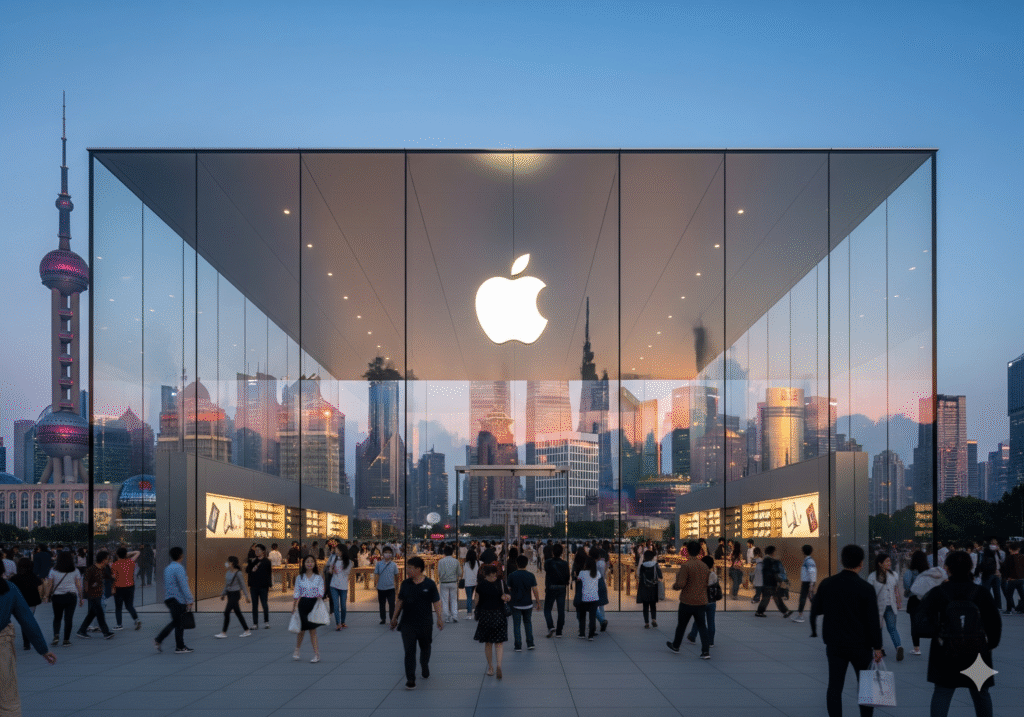
When I see pictures of that new Shanghai store, I don’t just see a retail location. I see a statement. It’s Apple saying, “We are all in on China.” And you have to ask, why would they double down amid so much criticism?
Well, imagine you built the most intricate, precise watch in the world. Now imagine almost every tiny spring, gear, and expert watchmaker existed in one single town. You wouldn’t just pick up and leave that town, would you? You’d build a beautiful flagship store there to show your commitment.
That’s China for Apple. It’s not just about cheap labor; it’s about an entire ecosystem of skill, scale, and speed that simply doesn’t exist anywhere else yet. As supply chain expert Prof. Willy C. Shih from Harvard Business School puts it in his article Global Supply Chains in a Post-Pandemic World (https://hbr.org/2020/09/global-supply-chains-in-a-post-pandemic-world), “The magic isn’t just the factory; it’s the cluster of suppliers, innovators, and engineers all in one region.” This network took 30 years to build. You can’t replicate it in 30 months.
So, when Tim Cook bows to pressure, he’s not being weak. He’s being pragmatic. He’s playing a long game where the immediate goal is to keep the lights on and the iPhones shipping—a product that, by the way, supports millions of jobs in design, engineering, and marketing right here in the United States. Also, you can see Apple’s design commitment explicitly in its opening of the Apple Jing’an store in Shanghai (https://www.apple.com/newsroom/2024/03/apple-jingan-now-open-in-shanghai/), which showcases not just sales space but cultural programs and supplier relationships.
How to Navigate an Impossible Situation (A Masterclass in Walking a Tightrope)
So, how does a company actually do this? How do you operate in a market whose government’s values often conflict with your own? From my observation, Apple’s playbook has a few key chapters:
- Become Irreplaceably Local: Apple doesn’t just sell in China; it lives there. It ensures WeChat and Alipay work flawlessly on its phones. It creates special product editions for Chinese holidays. Its stores become community hubs, not just transactional spaces. They’re not a foreign company; they’re a friendly local giant.
- Comply, But Draw Lines (Sometimes): Apple follows local laws, which has meant moving Chinese users’ iCloud data to servers operated by a state-owned company. This is a bitter pill to swallow for privacy advocates. But it’s also publicly refused requests it deemed overreaching, proving its negotiations are constant and complex.
- Diversify Like Your Business Depends on It (Because It Does): This is the most important part of the story. The loudest answer to critics isn’t a press release; it’s action. Apple is pouring billions into manufacturing in India and Vietnam. I’ve seen the reports of production lines ramping up, creating new hubs of expertise. It’s a risky, expensive insurance policy—and a direct response to the very criticism Barr is leveling.
It’s Not Just Good vs. Evil: Seeing the shades of grey
It’s so easy to see this as a simple morality tale: the greedy corporation vs. the principled politician.
But life is messier than that. Is Apple empowering an authoritarian government? In some ways, undoubtedly. But is it also creating a middle class, fostering technical skills, and connecting millions of Chinese people to the global community? Also yes.
I remember talking to a young app developer in Beijing a few years ago. For her, an iPhone wasn’t a political statement; it was a passport. A tool to build a business and reach a global audience. That human element often gets lost in the geopolitical debate.
The Ripple Effect: What This Means for You and Me
You might be wondering, “Okay, but how does this affect me?”
Well, it directly impacts the price and availability of the tech we love. Severe decoupling could lead to shortages and skyrocketing costs. It affects the global economy, which touches our investments and job markets. And on a deeper level, it forces us to ask hard questions about the products we buy: What are we supporting? What are we compromising? There are no easy answers, but they’re questions worth asking.
A View from the Ground
A friend who lives in Shanghai sent me a video of the new store opening. The energy was electric. “You have to understand,” she said, “this isn’t about buying a phone. It’s about being seen. It signals that Shanghai is a first-tier global city. That we matter.” That sense of pride and validation is a powerful force that Apple understands intuitively.
An Expert’s Sobering Take
I was discussing this with a colleague who specializes in international trade. She offered a perspective that stuck with me:
“Apple is the leading indicator. Its struggles are a preview of what’s to come for countless global companies. They are trying to prove that deep interdependence can still work in a world that’s fragmenting. It’s the most difficult corporate strategy on the planet right now, and everyone is watching to see if it succeeds.”
Your Questions, Answered
Is Apple moving out of China for good?
They’re moving some production, notably of iPhones, to countries like India to diversify risk. But China remains its primary manufacturing base due to its unparalleled scale, infrastructure, and expertise. A full exit is neither planned nor practical anytime soon.
Why does the U.S. government care so much?
Officials like Barr argue that relying on a strategic competitor for critical technology is a national security risk. They fear China could use its leverage over Apple for espionage or to gain economic concessions during a dispute.
How many Apple stores are actually in China?
With this new opening, Apple now operates 48 stores in mainland China. That’s more than in any other country outside the U.S., showing just how vital the market is to their global retail strategy.
Does this mean my data in China isn’t safe?
iCloud data for Chinese customers is stored on servers operated by a state-owned company, Guizhou-Cloud Big Data, in compliance with Chinese law. This means it is subject to local privacy and security laws, which differ significantly from those in the West.
What would happen if China suddenly kicked Apple out?
It would be economically devastating for both sides. China would lose millions of jobs and a key technology partner. Apple would lose its largest manufacturing base and a huge consumer market, likely causing massive global product shortages and financial turmoil.
The Takeaway: It’s All About Connection
At the end of the day, this story isn’t about a store or a critic. It’s about connection. We live in a world where a device designed in California, made with parts from a dozen countries, and assembled in China is a symbol of both incredible human collaboration and tense geopolitical friction.
Apple is trying to hold onto that collaborative ideal, even as the world pulls it apart. It’s messy, imperfect, and incredibly difficult. And it’s a reminder that the products we use every day are born from a world of complexity we rarely see.
What do you think? Is this a strategy that can last? I’d love to hear your perspective.