
Introduction
Some scientists change the way we think. Others change the way we see. Hans Dehmelt, who passed away at the age of 94, did both. A Nobel Prize–winning physicist, Dehmelt found a way to do something once thought impossible: trap and study a single electron. For most of us, electrons feel like ghosts-unseen, abstract, impossibly tiny. But for Dehmelt, they were treasures worth chasing. His curiosity and precision reshaped modern physics and paved the way for technologies you likely use every single day, from GPS navigation to quantum research.
As I reflect on his story, I can’t help but remember the awe I felt in college when I first read about his invention, the Penning trap. The idea that you could “hold” the smallest piece of matter—an electron—felt like pulling starlight into a jar. Let’s walk through what he achieved, why it mattered, and how his legacy lives on.
The Challenge: Studying What Can’t Be Seen
Imagine trying to measure the heartbeat of a hummingbird while it’s flying full speed. That’s what studying electrons felt like for scientists in the mid-20th century. Electrons are unimaginably small-about 2,000 times lighter than a proton-and they move so quickly that most experiments blurred into averages rather than precise measurements.
Traditional physics methods relied on smashing particles together in giant accelerators. It was messy, indirect, and often limited in accuracy. Scientists could make guesses about electron behavior, but they couldn’t zoom in on one particle and say, “There. That’s exactly how it works.”
Dehmelt saw the problem differently. Instead of scaling up, he thought: what if we could slow everything down? What if, instead of watching thousands of electrons in chaos, we studied one? It was a radical idea at the time-and that’s what made it brilliant.
How Hans Dehmelt Made the Impossible Possible
So, how did he do it? Step by step, with patience, persistence, and a little ingenuity.
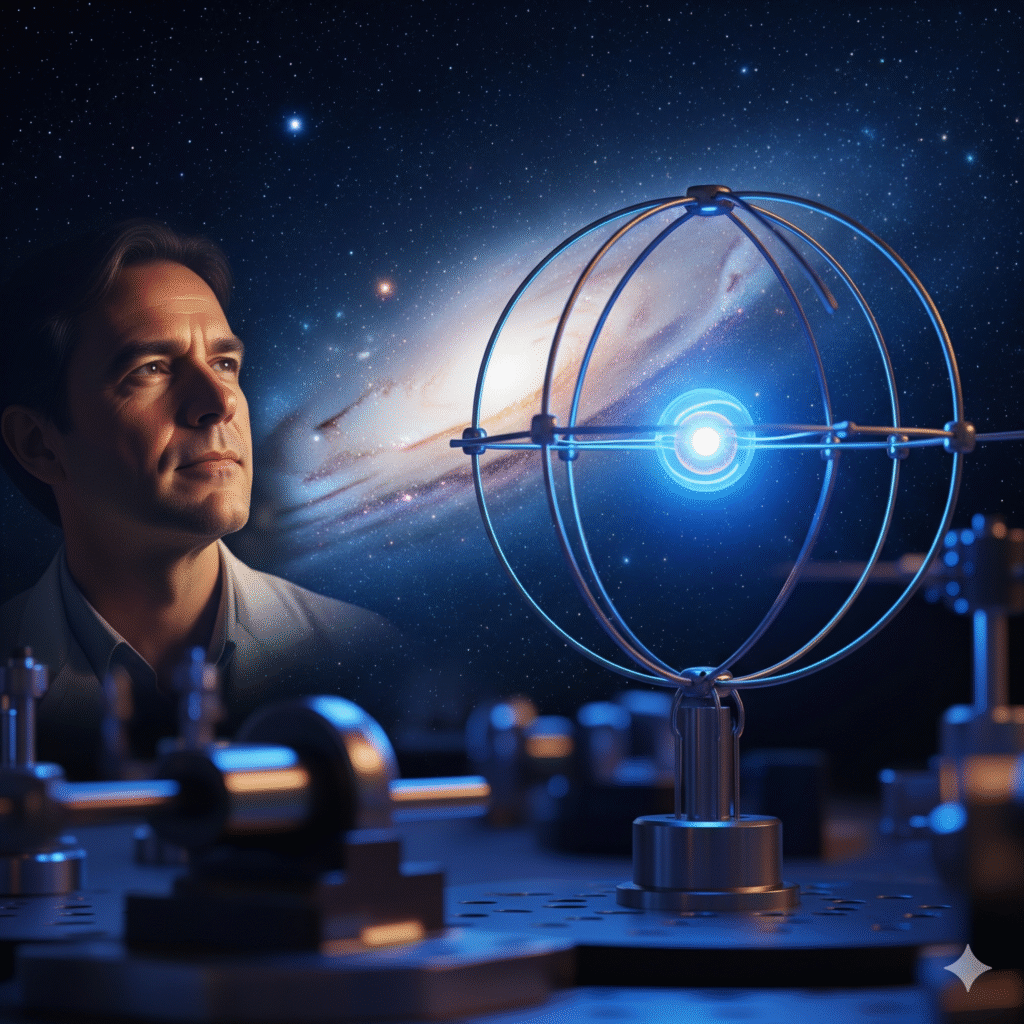
- The Penning Trap – Dehmelt’s star invention used magnetic and electric fields to confine a single charged particle, like an electron, in a kind of invisible cage. Picture a firefly hovering inside a glass orb-you can watch it without letting it escape.
- Isolating a Single Electron – By carefully adjusting the trap, he managed to capture just one electron. That was unheard of. Suddenly, scientists could examine its behavior in exquisite detail.
- Measuring with Unprecedented Precision – With the electron “caged,” Dehmelt measured its magnetic moment (a property that shows how it interacts with magnetic fields) with record-breaking accuracy. These results provided crucial confirmation for quantum electrodynamics (QED), one of the most precise and successful theories in all of physics.
- Sharing the Nobel Prize – In 1989, he shared the Nobel Prize in Physics with Wolfgang Paul (who designed the first trap for ions) and Norman Ramsey (known for his work on atomic clocks). Together, their contributions shaped the field of precision measurement.
I remember my physics professor explaining this with a grin: “Dehmelt didn’t just find a needle in a haystack-he figured out how to put the needle in a box and study it under a microscope.”
Comparing the Old Way and Dehmelt’s Way
Before Dehmelt, particle physics was a bit like trying to learn about a forest by setting off fireworks inside it: dramatic, but not very precise.
- Old Methods: Particle accelerators smashed atoms together to infer properties. Results were powerful but averaged across millions of particles.
- Dehmelt’s Method: Trapped one electron in a controlled environment and studied it patiently. The difference? Stunning clarity.
It was the shift from blurry snapshots to a crystal-clear portrait. That clarity changed everything-from confirming theoretical predictions to designing new tools for science.
Why His Legacy Still Touches Our Daily Lives
It might feel like this story belongs only in physics textbooks, but its fingerprints are all over modern life.
- GPS Accuracy – Ever wondered how your phone knows where you are? Atomic clocks, which rely on the kind of precision Dehmelt’s work enabled, power the system.
- Quantum Computing – The idea of isolating and controlling single particles is now the foundation of quantum computers, which promise to revolutionize medicine, finance, and cybersecurity.
- Medical Imaging & Lasers – Techniques derived from precision particle control improve imaging and laser technologies used in hospitals.
- Scientific Curiosity – His work is also a reminder that big breakthroughs don’t always come from bigger machines. Sometimes they come from looking closer.
When I use Google Maps and see that tiny blue dot keeping me from getting lost, I think about Dehmelt. He never set out to build GPS, but his curiosity about electrons nudged humanity one step closer to it.
Expert Insights
“Dehmelt’s achievement was an exercise in patience as much as in physics,” said Steven Chu, fellow Nobel laureate and former U.S. Secretary of Energy. “By isolating a single electron, he gave us a level of precision that reshaped experimental science. His work still underpins technologies we’re building today.”
That’s the mark of true genius: when your discoveries outlive you and continue shaping the future.
FAQs
Q1: What was Hans Dehmelt best known for?
He was best known for isolating and studying a single electron using the Penning trap, which earned him the Nobel Prize in Physics in 1989.
Q2: What is the Penning trap?
It’s a device that uses electric and magnetic fields to confine charged particles, like electrons or ions, in place-allowing scientists to study them in great detail.
Q3: How did his work impact everyday technology?
Dehmelt’s precision methods influenced atomic clocks, which power GPS, telecommunications, and even financial transactions. His ideas also paved the way for quantum computing.
Q4: Did Hans Dehmelt work alone?
Not entirely. He shared the Nobel Prize with Wolfgang Paul and Norman Ramsey, whose complementary work helped shape modern precision measurement.
Q5: Where did he teach?
Dehmelt spent much of his career at the University of Washington in Seattle, mentoring young scientists and carrying out his Nobel-winning research.
Q6: Why is isolating a single electron important?
It allowed scientists to make ultra-precise measurements that tested-and confirmed-the predictions of quantum theory, one of physics’ most fundamental frameworks.
Conclusion
Hans Dehmelt’s passing at 94 closed a remarkable chapter in physics, but his influence lives on in every GPS signal, every quantum experiment, and every student inspired by the elegance of science. By daring to ask whether it was possible to trap the tiniest piece of matter, he showed us that even the smallest curiosities can lead to world-changing discoveries.
If you take one lesson from his story, let it be this: sometimes the answers that transform our world don’t come from looking bigger or louder, but from looking closer, quieter, and with relentless curiosity.
Want to learn more? Explore the Nobel Prize’s official biography of Hans Dehmelt for a deeper dive into his life and legacy.