
Introduction: Why Jupiter Still Captivates Us
When I was a kid, I remember borrowing my neighbor’s telescope on a cool winter night. I could barely make out Jupiter — just a glowing dot with faint stripes — but even that blurry view gave me chills. Fast-forward to today, and we have spacecraft like Juno sending back high-definition images that look more like abstract paintings than pictures of a planet.
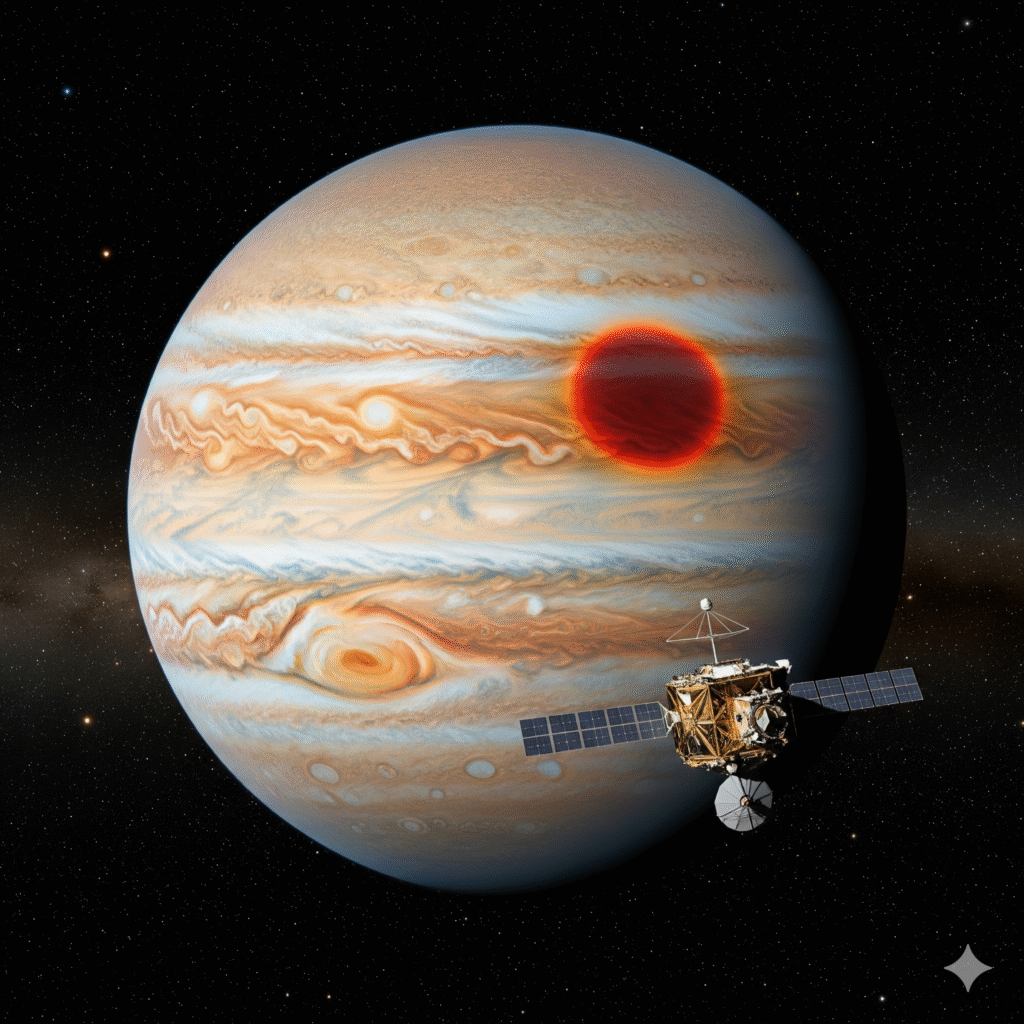
These photos of Jupiter from NASA spacecraft, both near and far, aren’t just pretty postcards. They’re scientific treasure troves that tell us how gas giants work, how planets form, and maybe even how life could exist elsewhere. And honestly? They remind us how small, fragile, and wonderfully curious we really are.
Jupiter Through the Lens of NASA: A Context We Can’t Ignore
For centuries, Jupiter was a mystery — a bright dot in the sky with tantalizing hints of bands through early telescopes. Things changed dramatically in 1979, when NASA’s Voyager 1 flew by and snapped the first close-up images of the Great Red Spot. Suddenly, what was once a textbook diagram became a living, breathing world.
Since then, every mission — Galileo in the 1990s, Cassini’s flybys, and today’s Juno — has layered detail upon detail. The latest JunoCam photos reveal storms so large they could swallow Earth whole, cloud swirls that look like Van Gogh paintings, and auroras that put our Northern Lights to shame.
Think about it: Jupiter is 318 times the mass of Earth, yet it spins so fast a “day” lasts under 10 hours. No wonder its atmosphere is a chaotic masterpiece.
How NASA Captures These Breathtaking Photos
You might wonder: how do we even take pictures of a planet nearly 600 million kilometers away? The answer is both science and artistry.
- Spacecraft flybys and orbits – Missions like Voyager gave us quick snapshots during flybys. Juno, on the other hand, has been orbiting Jupiter since 2016, circling in elongated paths that bring it dangerously close to the cloud tops.
- Specialized cameras – JunoCam isn’t a tourist camera; it’s designed to handle intense radiation while capturing light in multiple wavelengths. Some photos are “true color,” while others are processed to highlight specific features like ammonia clouds or deep atmospheric bands.
- Citizen science – Here’s the part I love: NASA releases raw image data, and ordinary people — hobbyists, artists, even high-school students — process them. That’s why many of the iconic Jupiter photos you’ve seen online are collaborations between engineers and everyday dreamers.
It’s almost poetic: the biggest planet in our solar system is being revealed not just by scientists, but by curious minds all over the world.
Hubble vs. Juno vs. Ground-Based Telescopes: A Comparison Worth Noting
Now, you might be asking — if we already have the Hubble Space Telescope, why do we need Juno? Great question. The answer is perspective.
- Hubble’s strength is distance. Orbiting Earth, it gives us wide, stable views of Jupiter’s atmosphere and seasonal changes.
- Juno’s strength is intimacy. Flying within 5,000 km of the cloud tops, it sees details Hubble could never resolve. Imagine looking at a city skyline from an airplane window versus walking through the streets — both perspectives matter.
- Ground-based telescopes add yet another angle, letting scientists track fast-changing storms in real time. Observatories like those in Hawaii and Chile often alert NASA when something unusual happens, like a comet slamming into Jupiter’s atmosphere.
Together, these tools give us a 3D understanding: the zoomed-out view, the intimate close-ups, and the live monitoring.
Why Jupiter’s Photos Matter to Us Back on Earth
You might think, “Okay, cool pictures… but how does this affect me?” Let’s connect the dots.
- Studying planetary weather – Jupiter’s storms are like Earth’s hurricanes on steroids. By studying them, scientists refine models that can also improve long-term weather and climate predictions here.
- Clues to planetary formation – Gas giants like Jupiter formed early in the solar system. Understanding its core and atmosphere gives us hints about how Earth itself came to be.
- Protection of Earth – Fun fact: Jupiter acts like a cosmic vacuum cleaner. Its massive gravity pulls in comets and asteroids that might otherwise hit us. Seeing impact scars in photos isn’t just fascinating — it’s a reminder that without Jupiter, Earth’s history might have been very different.
- Cultural and personal impact – I’ve seen classrooms light up when students look at Juno’s images for the first time. It’s a reminder that science isn’t just data; it’s wonder. And wonder is often the spark that drives the next generation of explorers.
Expert Insights: What NASA Says About Jupiter’s Photos
Dr. Scott Bolton, principal investigator of the Juno mission, once said:
“Every time we fly by Jupiter, we discover something new. Its beauty is matched only by its complexity.”
That’s the thing — these images aren’t static. They’re snapshots of a restless giant, always shifting, always surprising us.
You can dive into raw images yourself at NASA’s JunoCam site and even try your hand at processing them. It’s science, but also a form of art that anyone can participate in.
FAQs
Q: What is the most famous photo of Jupiter?
The Great Red Spot captured by Voyager 1 in 1979 is still iconic. But newer Juno images of Jupiter’s polar storms may be just as legendary in the years ahead.
Q: Can you see Jupiter’s photos in real time?
Not exactly. Spacecraft send data back in batches, which NASA processes and shares online. However, ground-based telescopes let you watch some features in near-real time.
Q: Why do Jupiter’s photos look so colorful?
Some colors are natural, while others are enhanced. Scientists adjust the data to highlight gases, cloud depths, and chemical reactions — making hidden features visible.
Q: How close has Juno gotten to Jupiter?
At its closest, Juno has swooped within about 2,600 miles (4,200 km) of Jupiter’s clouds — closer than any spacecraft before.
Q: Do Jupiter’s photos help us search for life?
Indirectly, yes. By studying Jupiter and its moons (like Europa, which may have subsurface oceans), we learn about the environments where life could exist.
Conclusion: A Call to Wonder
Looking at photos of Jupiter from NASA spacecraft, both near and far, is humbling. They’re not just scientific records; they’re reminders of what’s possible when curiosity drives us beyond our backyard.
The next time you see one of those swirling, stormy portraits online, pause for a moment. Ask yourself: if we can reveal the secrets of a planet half a billion miles away, what wonders might we uncover right here on Earth?
If this inspired you, take a peek at NASA’s raw images. Who knows — maybe your own processed Jupiter photo will be the one to spark wonder in someone else.